What inspires you when you are writing?
A lot of people have playlists, but I don't listen to music when I write (I can't write with someone else's words in my head). I'm a visual person. Images evoke emotion for me.
Just this past week, a new short story idea caught me. Little pieces started to come together...herbal lore, rural Vermont, a clapboard farmhouse turned restuarant, romance. And kissing. The images were twirling in my head, that ethereal dance before words hit the page.
I posted recently about how turned to different creative pursuits to get past writer's block and opened my own Etsy shop Faerie Lights Studio to get past it. I've been enjoying myself, spending a lot of time looking at the beautiful items people are offering.
Etsy has a lovely feature called a Treasury. You can create a collection of items that you love, things that you want, things that inspire you. It's a visual favorites list. It can be public or just for you. And you can include anything. There are over eleven million items on Etsy. That's a lot of inspiration.
To help those ethereal thoughts find a earthbound home, I created a treasury called Idlewyld Inspirations, full of items that inspire me as I write my new story. I love the photography, the beautiful aura that these artists imbue in their products. I almost feel I'm there...
I wrote over 1000 words last night (very rare for me to write when my family is home), with a pen (unheard of), and then got up in the night to write 500 more (used to be common, but hasn't happened in a while). My block seems to be broken and I have Etsy to partially thank for it, in more ways than one.
So if you are seeking inspiration or an image to represent something in your head, Etsy's a great place to go.
And if you do, pop by Faerie Lights Studio, where I'm selling a new range of Christmas lights and pendants. I'm offering a special discount to anyone visiting from the blog. Just enter coupon code INSPIRE15 to save 15% on any purchase! Feel free to pass this coupon code on to an friends or family.
Have an inspired day!
Showing posts with label writing process. Show all posts
Friday, November 18, 2011
Tuesday, July 5, 2011
Guest Post at The Writer's Salon
My wonderful critique partner Jacqueline Cangro asked me to write a guest post for her blog at The Writer's Salon. (I meant to link to this last week but things have gotten away from me. Again. Sorry, Jackie!)
So in keeping with my love for all things tech, I've written about the mechanical things you can do as you are getting ready for the big job of rewriting. Check out my post here.
And while you are at it, take a look at the The Writer's Salon, an alternative to formal MFA programs and continuing education classes located in Brooklyn. Each 1-1/2 hour Saturday session is geared to a specific topic. Sessions fall into two categories:
So in keeping with my love for all things tech, I've written about the mechanical things you can do as you are getting ready for the big job of rewriting. Check out my post here.
And while you are at it, take a look at the The Writer's Salon, an alternative to formal MFA programs and continuing education classes located in Brooklyn. Each 1-1/2 hour Saturday session is geared to a specific topic. Sessions fall into two categories:
- Writing techniques. Here is all of the must-have info you need to succeed at the craft of writing, no matter what genre. You'll learn tips and tricks about writing amazing dialogue, fixes for common plot problems and much more!
- The “business” of writing. This is the insider's guide to publishing, including writing query letters that get noticed and the brave new world of e-books. If you have a completed or almost-completed manuscript and you’re wondering what the next step is, these sessions are for you.
Tuesday, June 21, 2011
Comparing Documents in Word
I've revised my WIP nine times. That's right...nine times. Sometimes, I wonder if anything of the original draft remains.
If only there were some way to see how many changes I've made and how the first version compares to the last.
Oh, but there is! (You knew you could count on me for more Word nerdery, right?)
Using Word's Compare Documents feature, you can compare two documents and see the number of insertions, deletions, moves, and format changes. You could also use it find passages that you deleted that you wish you'd hadn't. Of if you have a critique partner that didn't use track changes and made edits directly in your document.
You'll find the Compare button on the Review tab. Here, I've taken an early draft and the most recent (not final, because hey, it's never final, right?) and selected the option to compare them in a new document.
Once you select your original and revised document, you'll see a new document with all the changes combined (marked in the image below with a blue box).
You can select to see the original document (green circle) and revised document (purple circle) on the right hand side. These will scroll in time with the new document.
The red circled area on the left is the reviewing pane. You can put this either vertically, as above, or horizontally, as a long pane below the other documents. The reviewing pane shows the individual changes, plus a count of all the changes made. And since I'm all about the stats, here are the numbers for my WIP:
4983 revisions.
Funny, it felt like more.
Do you ever use Compare Documents?
If only there were some way to see how many changes I've made and how the first version compares to the last.
Oh, but there is! (You knew you could count on me for more Word nerdery, right?)
Using Word's Compare Documents feature, you can compare two documents and see the number of insertions, deletions, moves, and format changes. You could also use it find passages that you deleted that you wish you'd hadn't. Of if you have a critique partner that didn't use track changes and made edits directly in your document.
You'll find the Compare button on the Review tab. Here, I've taken an early draft and the most recent (not final, because hey, it's never final, right?) and selected the option to compare them in a new document.
Once you select your original and revised document, you'll see a new document with all the changes combined (marked in the image below with a blue box).
You can select to see the original document (green circle) and revised document (purple circle) on the right hand side. These will scroll in time with the new document.
The red circled area on the left is the reviewing pane. You can put this either vertically, as above, or horizontally, as a long pane below the other documents. The reviewing pane shows the individual changes, plus a count of all the changes made. And since I'm all about the stats, here are the numbers for my WIP:
4983 revisions.
Funny, it felt like more.
Do you ever use Compare Documents?
Monday, May 23, 2011
Your Greatest Critic
My latest Woman's Weekly story, "Frozen" -- a four-part serial exploring the implications of embryo donation -- is out on the newsstands this month. I just received my contributor copies of the first installment, but the others will take a few weeks to get here. It can be hard waiting for them all to arrive, so I rely on comments from my in-laws in the UK to let me know that each new issue has hit the stands.
The Wallaces have always been super-supportive of my writing. Whenever we Skype or chat on the phone, they always ask me how the writing is going or if I'm working on something new. When I have a serial published, they are the first to tell me they are reading and enjoying it. This time, my father-in-law told me that it is "by far" the best story I've written. My mother-in-law said it sparked a lively discussion in her sewing group. Their praise means more to me than they'll ever know. Today, I sat down at the computer raring to write the next serial, because I felt like I must be doing something right.
We need our critics to make us better. We need our critics to make us feel that we are better. It can be hard to share your work, especially if you are new to this. But it is essential. So if you don't have your greatest critic, get one. It will make you a better writer.
Friday, May 6, 2011
Visually Mapping Tension in Your Manuscript
I think we've established I'm a bit of a geek. (If you don't believe me, go check out my posts on storyboarding and statistics). I love what programs like Word, Excel and Writer's Cafe can do for me at the click of a few buttons. If you are a visual person, like I am, there are tons of ways you can use these programs to help you with your writing other than just putting words on a page.
I've finally finished the revision on my WIP (phew!). While it is with my beta readers, I'm going through and polishing it up. One of the most critical elements I'm checking is that I have effectively woven my conflict threads (internal, external, and relationship) through the entire book, building tension to the end. Reading through is one thing, but I find it a bit tedious to take written notes as I read. So it got me thinking: what if there was a way to see at a glance how conflict and tension build through my manuscript? There is!
I'm using Text Highlighting to do this. I've assigned each conflict thread a different color:
Internal- yellow
External -red
Relationships (there are three) blue, pink and green.
This WIP contains a story within a story. This storyline will get a separate highlighting treatment, so for the time being I've highlighted it in black so that I know to overlook it this pass through.
So then I've gone through the manuscript and highlighted each scene of conflict in the appropriate color, like this:
Then, I change the zoom level down to 10% so that I can see multiple pages in the window like this:
It gives me an instant visual of where my conflict threads are and how they weave together. I can start at the beginning and scroll down, making sure I continue to build the tension throughout. I can click on a thread in question and zoom back in so I can read it. At a glance, I can see if there are scenes/chapters without some form of conflict, like this:
See the red-circled area? It looks like I might have a lull so I'm marking that down on my list of things to work on after I get my beta feedback. (I'm not making any changes in this particular document -- I've saved this as a separate file).
It only took me about an hour or so to do this and I think it will save me lots of time in the long run.
Do you have any visual tricks you use while editing or writing?
I've finally finished the revision on my WIP (phew!). While it is with my beta readers, I'm going through and polishing it up. One of the most critical elements I'm checking is that I have effectively woven my conflict threads (internal, external, and relationship) through the entire book, building tension to the end. Reading through is one thing, but I find it a bit tedious to take written notes as I read. So it got me thinking: what if there was a way to see at a glance how conflict and tension build through my manuscript? There is!
I'm using Text Highlighting to do this. I've assigned each conflict thread a different color:
Internal- yellow
External -red
Relationships (there are three) blue, pink and green.
This WIP contains a story within a story. This storyline will get a separate highlighting treatment, so for the time being I've highlighted it in black so that I know to overlook it this pass through.
So then I've gone through the manuscript and highlighted each scene of conflict in the appropriate color, like this:
Then, I change the zoom level down to 10% so that I can see multiple pages in the window like this:
It gives me an instant visual of where my conflict threads are and how they weave together. I can start at the beginning and scroll down, making sure I continue to build the tension throughout. I can click on a thread in question and zoom back in so I can read it. At a glance, I can see if there are scenes/chapters without some form of conflict, like this:
See the red-circled area? It looks like I might have a lull so I'm marking that down on my list of things to work on after I get my beta feedback. (I'm not making any changes in this particular document -- I've saved this as a separate file).
It only took me about an hour or so to do this and I think it will save me lots of time in the long run.
Do you have any visual tricks you use while editing or writing?
Thursday, February 10, 2011
Call for Advice on First Chapters and Opening Pages
I fell prey to the classic rookie mistake in my first novel: starting the book in the wrong place. Chapter 1 had lots of backstory and not enough conflict. It was, to say the least, a boring chapter.
As I get to work on my next project, I am DETERMINED that I will not make the same mistake. To that end, I started trolling around the interwebs for good posts on first sentences, first paragraphs, opening pages, and first chapters. I've found some great stuff (I am loving Elena Solodow's list of overdone openings from Nathan's first paragraph contest -- I've already thrown out four opening ideas as a result) but I'm running out of steam. I follow 120 blogs and, boy, are you guys prolific! It was taking way too much time to go to everyone's blog and search for posts, so I have a favor to ask.
If you have written a post on openings, or have read a great post on the subject, can you leave a link (or non-linked address, if like me you are useless at HTML tagging) in the comments? Or maybe you can recommend a book that has good coverage on the topic.
I thank you! (And I'm sure the agents who will someday be reading my opening pages will thank you, too.)
As I get to work on my next project, I am DETERMINED that I will not make the same mistake. To that end, I started trolling around the interwebs for good posts on first sentences, first paragraphs, opening pages, and first chapters. I've found some great stuff (I am loving Elena Solodow's list of overdone openings from Nathan's first paragraph contest -- I've already thrown out four opening ideas as a result) but I'm running out of steam. I follow 120 blogs and, boy, are you guys prolific! It was taking way too much time to go to everyone's blog and search for posts, so I have a favor to ask.
If you have written a post on openings, or have read a great post on the subject, can you leave a link (or non-linked address, if like me you are useless at HTML tagging) in the comments? Or maybe you can recommend a book that has good coverage on the topic.
I thank you! (And I'm sure the agents who will someday be reading my opening pages will thank you, too.)
Monday, February 7, 2011
Sit down, shut up, and everyone will get a turn
Except my brain is not cooperating. Z doesn't give a damn that I am not allowed to work on Z until the others are done. And AA is getting ticked off that it keeps getting shoved back. Y keeps reminding me that it only needs a few hours of my time. My brain is whirling with three different stories. I'm a little worried that there will be bloodshed. X is tough, but I'm pretty sure AA can take 'em. They're all giving me a headache and I am losing sleep. I had a massage today and I spent most of it spinning from X to Z and back to AA.
Do you have this problem? What do you do when you have multiple ideas demanding attention?
Thursday, January 27, 2011
Not built for waiting
Writers are the worst people for waiting. At least this writer is. And the cruelty of this business is that it is all about waiting. Waiting for critiques, waiting for responses on queries, waiting for news on partials or fulls, waiting for results of submissions, waiting for publication, reviews, and on and on.
So we have all the time in the world to think things like...
"OK, it's been 56 hours since I clicked the Send button on my submission. I haven't heard anything back yet. That must mean if got lost in cyberspace." or "No news is good news." followed by "No news is bad news."
It should just be waiting. But it isn't. It is dedicated time for our fertile imaginations to go into overdrive.
Two days ago, I sent my latest serial to the magazine editor for approval. And now I have what I call Refresh Syndrome (the main symptom is uncontrollable clicking of the Refresh button on my inbox). I haven't heard back yet.
Key frantic imaginings, which go along the lines of "I haven't heard back yet because the fiction editor must have liked it enough to send it to the editor in chief, who is now reading it. That's a good sign." Which is immediately followed by "I haven't heard back yet because there is something in it she doesn't like and is writing the revision letter." Logic -- meaning the voice that says "It's only been two days and they have other things to do. Relax."-- has no place here.
My husband is a scientist. Scientists have to wait, too. But they don't stand over an experiment muttering to themselves and thinking up multiple scenarios about what is going on, all while knowing that it will be days before they can expect some kind of meaningful results. No, they just make notes and get on with another project.
Waiting requires us to be detached, cool, logical. These are not things a writer is known for. At least not this writer. Yet one more of the bitter ironies of the writer's world.
So we have all the time in the world to think things like...
"OK, it's been 56 hours since I clicked the Send button on my submission. I haven't heard anything back yet. That must mean if got lost in cyberspace." or "No news is good news." followed by "No news is bad news."
It should just be waiting. But it isn't. It is dedicated time for our fertile imaginations to go into overdrive.
Two days ago, I sent my latest serial to the magazine editor for approval. And now I have what I call Refresh Syndrome (the main symptom is uncontrollable clicking of the Refresh button on my inbox). I haven't heard back yet.
Key frantic imaginings, which go along the lines of "I haven't heard back yet because the fiction editor must have liked it enough to send it to the editor in chief, who is now reading it. That's a good sign." Which is immediately followed by "I haven't heard back yet because there is something in it she doesn't like and is writing the revision letter." Logic -- meaning the voice that says "It's only been two days and they have other things to do. Relax."-- has no place here.
My husband is a scientist. Scientists have to wait, too. But they don't stand over an experiment muttering to themselves and thinking up multiple scenarios about what is going on, all while knowing that it will be days before they can expect some kind of meaningful results. No, they just make notes and get on with another project.
Waiting requires us to be detached, cool, logical. These are not things a writer is known for. At least not this writer. Yet one more of the bitter ironies of the writer's world.
Monday, October 4, 2010
Pantserfail
Remember when I said I was changing teams from Plotter to Pantser? Yeah, well, I lied. Boy, did I lie.
Because I'm guessing that Pansters don't make spreadsheets like this when working out their characters:
I don't know...maybe they do (hey pantsers -- do you?). But I'm fairly certain they don't do this:
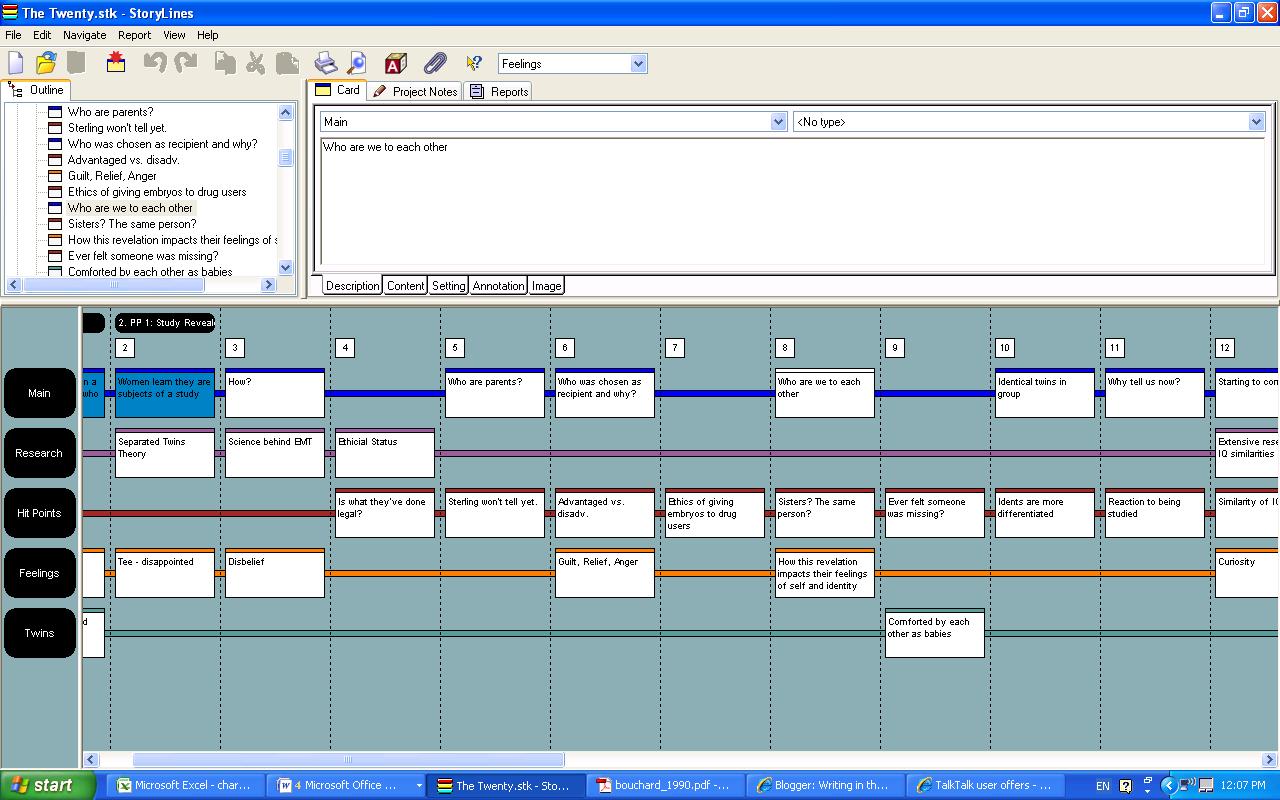
This is a screen shot of the Storylines program from the Writer's Cafe software, which uses virtual index cards that you can move up, down, all around. You can have multiple plot lines. I use it for the main and subplots (blue and green) and to keep track of my "hit points" or important moments or ideas in the story (that's the red line), my relevant research (purple line), and emotions (orange lines). Key scene cards are blue and the acts are denoted by the black markers at the top.
What can I say? Try as I might, I couldn't work by the seat of my pants. I just like my spreadsheets and charts too darn much. I need them. I feel more comfortable when I have a road map for my journey. And after today, I feel more energy than fear, which is a good thing. So I'll hand back my temporary Pantser membership card. Thanks for having me! Maybe I'll join you again some other time.
Because I'm guessing that Pansters don't make spreadsheets like this when working out their characters:
I don't know...maybe they do (hey pantsers -- do you?). But I'm fairly certain they don't do this:
This is a screen shot of the Storylines program from the Writer's Cafe software, which uses virtual index cards that you can move up, down, all around. You can have multiple plot lines. I use it for the main and subplots (blue and green) and to keep track of my "hit points" or important moments or ideas in the story (that's the red line), my relevant research (purple line), and emotions (orange lines). Key scene cards are blue and the acts are denoted by the black markers at the top.
What can I say? Try as I might, I couldn't work by the seat of my pants. I just like my spreadsheets and charts too darn much. I need them. I feel more comfortable when I have a road map for my journey. And after today, I feel more energy than fear, which is a good thing. So I'll hand back my temporary Pantser membership card. Thanks for having me! Maybe I'll join you again some other time.
Tuesday, September 21, 2010
Switching Teams
I had years to stew on my first novel, The Shadow Scribe. Decades actually. I would say that I had about 50% of it written in my head before I ever put it on paper. I knew the characters, the setting was crystal clear, the plot defined. I considered myself the ultimate plotter, with every chapter outlined before I ever started writing.
In contrast, my new idea is just that -- an idea. My plot diagram is complete (I use Aristotle’s Incline which I learned from Robert Ray’s The Weekend Novelist but I also like the Screenplay Structure method) but when I try to outline it, I find myself writing things like “stuff happens here.”
I know that it is the kind of story that can only evolve as I write. Which means that I am about to have my first experience as a pantser. GASP! Some nights, I lay awake paralyzed by fear. What if I can't write it? What if it fizzles out?
But I also have moments of real optimism. I have no preconceived ideas of exactly how this story will go. I know my first novel is weaker because I could only imagine one way to write it. While I’m nervous about switching teams from plotter to pantser, I’m excited too.
There are lots of posts out there on plotters vs pantsers (like this excellent one by Roni at *Fiction Groupie*) so I’m not going to get into the definitions. But what I want to know is: Have you ever switched teams (plotter to pantser or pantser to plotter)? Do you ever wish you were one instead of the other?
Tuesday, September 14, 2010
What to write, what to write...
I stressed a lot about what my next novel project would be. I have no shortage of ideas – actually, it’s just the opposite. My ideas run the gamut of genres, including YA, MG, historical, paranormal, women’s fiction, sci fi, and literary. And as we all know, some genres are a tougher sell than others.
Every agent and writer blog out there will warn you against writing to pursue a trend, or even to pursue publication. They all say that you should write the book that moves you and write the best version of it possible. Great advice, to be sure.
But I do think there is something to be said for picking your projects wisely. For instance, most editors and agents are saying that the vampires are played out. So would it be wise to start a vampire novel now, knowing that by the time you finish it, the market will have moved on? If that is what you are compelled to write, then do it. But don’t expect that professional success with that book will be easy (granted, nothing about this business is easy).
Maybe you’ve heard the expression, “Marry for love, not money, but have the sense to fall in love with a rich man (or woman).” I think this applies to writing, too. If you want to be a professional writer, I think you must look at your projects pragmatically. All things being equal (meaning if you have three projects in mind that you are equally passionate about), you should pursue the project that has the most commercial viability. In the end, a book is a product and you want to produce a product people want to buy.
I write because I love to, but I also want to make a career out of it. So this is where the stress came in. I went round and round trying to decide which project had the most commercial promise. (I swear I would pay an agent right now to give me career advice on this subject!) I made pro and con lists, bored my husband stupid with endless speculation, traded countless emails with a writer friend, and lost a lot of sleep before finally coming to a conclusion.
In the end, passion for the story was the first criteria, and market was the second. I hated making the decision (I always second guess myself) but I feel good about it now. I can tell you I decided to pursue the literary fiction project, but beyond that I'll not say anything else about it yet. I'm not trying to be coy, just a little bit superstitious. Once I get past the research stage and into the writing, I'll be more comfortable talking about it.
Any thoughts on choosing a project based on commercial viability? Did you consider the markets when you started on a project?
Every agent and writer blog out there will warn you against writing to pursue a trend, or even to pursue publication. They all say that you should write the book that moves you and write the best version of it possible. Great advice, to be sure.
But I do think there is something to be said for picking your projects wisely. For instance, most editors and agents are saying that the vampires are played out. So would it be wise to start a vampire novel now, knowing that by the time you finish it, the market will have moved on? If that is what you are compelled to write, then do it. But don’t expect that professional success with that book will be easy (granted, nothing about this business is easy).
Maybe you’ve heard the expression, “Marry for love, not money, but have the sense to fall in love with a rich man (or woman).” I think this applies to writing, too. If you want to be a professional writer, I think you must look at your projects pragmatically. All things being equal (meaning if you have three projects in mind that you are equally passionate about), you should pursue the project that has the most commercial viability. In the end, a book is a product and you want to produce a product people want to buy.
I write because I love to, but I also want to make a career out of it. So this is where the stress came in. I went round and round trying to decide which project had the most commercial promise. (I swear I would pay an agent right now to give me career advice on this subject!) I made pro and con lists, bored my husband stupid with endless speculation, traded countless emails with a writer friend, and lost a lot of sleep before finally coming to a conclusion.
In the end, passion for the story was the first criteria, and market was the second. I hated making the decision (I always second guess myself) but I feel good about it now. I can tell you I decided to pursue the literary fiction project, but beyond that I'll not say anything else about it yet. I'm not trying to be coy, just a little bit superstitious. Once I get past the research stage and into the writing, I'll be more comfortable talking about it.
Any thoughts on choosing a project based on commercial viability? Did you consider the markets when you started on a project?
Thursday, September 9, 2010
The Blame Game
As you may have read yesterday, I had a bit of a crisis where my editor came back and asked me to change the ending of one of my story segments. I spent a good part of the day pouting because it was one of the parts that I thought really worked.
But then I reminded myself that I am a professional writer, which means that I am NOT ALLOWED to fall back on that idea that if a reader doesn't think something works, then it must be the reader's fault. I'm sorry, but that thinking is for amateurs.
Let me repeat that, because I think it is a critical idea that separates good writers from bad:
If your reader doesn't understand something in your story, it is YOUR fault as the writer, not their fault as the reader.
If you reader doesn't think something works, it means you have failed to communicate motivation, action, something. Just to make things complicated, sometimes what a reader says doesn't work isn't always the problem. They just know something is wrong, but can't put their finger on it and may give vague feedback that doesn't always make sense. This is where having savvy critique partners (who are writers, not just readers) who can put it in the language of the craft is essential.
For example, a reader may say "I didn't like it when Jane jumped out of the car." What didn't your reader like? The action? The timing? What Jane said when she threw herself out? Your knee-jerk reaction might be "But I can't cut that scene! It's critical to the action!"
When the problem is verbalized by a writer, it becomes clearer. "I don't think you've clearly shown Jane's motivation to jump out the car." Suddenly, you know how to fix the problem -- no, wait -- you know how to make your story BETTER. Your reader was right.
Remember, this is not the blame game. You cannot blame the reader for your mistakes as a writer.
The good news is that if you can accept this truth, it shows that you are a good enough writer to identify and fix your issues.
But then I reminded myself that I am a professional writer, which means that I am NOT ALLOWED to fall back on that idea that if a reader doesn't think something works, then it must be the reader's fault. I'm sorry, but that thinking is for amateurs.
Let me repeat that, because I think it is a critical idea that separates good writers from bad:
If your reader doesn't understand something in your story, it is YOUR fault as the writer, not their fault as the reader.
If you reader doesn't think something works, it means you have failed to communicate motivation, action, something. Just to make things complicated, sometimes what a reader says doesn't work isn't always the problem. They just know something is wrong, but can't put their finger on it and may give vague feedback that doesn't always make sense. This is where having savvy critique partners (who are writers, not just readers) who can put it in the language of the craft is essential.
For example, a reader may say "I didn't like it when Jane jumped out of the car." What didn't your reader like? The action? The timing? What Jane said when she threw herself out? Your knee-jerk reaction might be "But I can't cut that scene! It's critical to the action!"
When the problem is verbalized by a writer, it becomes clearer. "I don't think you've clearly shown Jane's motivation to jump out the car." Suddenly, you know how to fix the problem -- no, wait -- you know how to make your story BETTER. Your reader was right.
Remember, this is not the blame game. You cannot blame the reader for your mistakes as a writer.
The good news is that if you can accept this truth, it shows that you are a good enough writer to identify and fix your issues.
Friday, September 3, 2010
When we last left our hero...
Endings are important. This is a universal truth, right? But I'm going to step out a limb and say that the how your chapters end is more important than how your book ends. Why? Because while the end of your book impacts how the readers think about your book in total, it is how your chapters end that will keep your readers reading.
As novelists, we all want to write the book that has the reader saying over the watercooler, "I was up reading until 4 in the morning! I just couldn't put it down!"
My day job is writing serial fiction for a woman's magazine. Each story is three or four parts, 3800 words each. Each part must end in a way that makes the reader want to come back for more. The stakes are high here. The reader has to be so drawn in that they will think about it all week, go to the store, and shell out a few more bucks for the next issue so they can read what happens next.
The cliffhanger (named for the 1930s episodic movies where the hero was literally dangling from a cliff when the credits went down -- check out the Wiki link here) is so important for serials that I write the endings first. When I pitch a new idea to the editor, it is the overall story and the part endings that I pitch. Because if the endings don't work, the serial won't either.
This is a valuable technique for novelists. Every chapter needs to end in a way that makes the reader want to turn the page. Unfortunately, I learned this too late for my last project, where I structured that novel so that each chapter ended when my MC was going to bed. Looking back now, I see that was just an invitation for the reader to put down the book at the end of a chapter. The last thing you want is for your reader to say, "Nothing exciting is happening now, so this is a good spot for me to stop reading."
You don't have to leave your characters dangling off a cliff at the end of each chapter. Not every cliffhanger is mortal peril. It can end with a choice, a question, the prelude to a fight...anything has your reader wondering -- or even better, DEMANDING -- to know what happens next.
And that's why endings are..wait... excuse me a minute, there's an email in my inbox. I don't believe it! It's...
What does our hero find? Tune in next blog post to find out!
As novelists, we all want to write the book that has the reader saying over the watercooler, "I was up reading until 4 in the morning! I just couldn't put it down!"
My day job is writing serial fiction for a woman's magazine. Each story is three or four parts, 3800 words each. Each part must end in a way that makes the reader want to come back for more. The stakes are high here. The reader has to be so drawn in that they will think about it all week, go to the store, and shell out a few more bucks for the next issue so they can read what happens next.
The cliffhanger (named for the 1930s episodic movies where the hero was literally dangling from a cliff when the credits went down -- check out the Wiki link here) is so important for serials that I write the endings first. When I pitch a new idea to the editor, it is the overall story and the part endings that I pitch. Because if the endings don't work, the serial won't either.
This is a valuable technique for novelists. Every chapter needs to end in a way that makes the reader want to turn the page. Unfortunately, I learned this too late for my last project, where I structured that novel so that each chapter ended when my MC was going to bed. Looking back now, I see that was just an invitation for the reader to put down the book at the end of a chapter. The last thing you want is for your reader to say, "Nothing exciting is happening now, so this is a good spot for me to stop reading."
You don't have to leave your characters dangling off a cliff at the end of each chapter. Not every cliffhanger is mortal peril. It can end with a choice, a question, the prelude to a fight...anything has your reader wondering -- or even better, DEMANDING -- to know what happens next.
And that's why endings are..wait... excuse me a minute, there's an email in my inbox. I don't believe it! It's...
What does our hero find? Tune in next blog post to find out!
Friday, August 13, 2010
But you knew that
I'm in the process of working on my latest serial for Woman's Weekly. In "Continental Drift" a young woman who lost her husband a year ago drives from New York to Los Angeles to reconnect with a group of friends from college. I found writing Part 1 easy - the words just seemed to flow as she drove through the southern US and worried about starting her life over. Part 2 was trickier as I found it difficult to introduce the old relationships in enough detail to stay within the word count (I've got 3800 words per part).
When I finished part 2, I did something I've never done -- I sent the first draft of parts 1 and 2 to the fiction editor for her feedback. Usually, I finish all the parts and do a final polish (I wouldn't call them final drafts because I know there may be revisions). But this time, I felt I needed to hear from the editor that things were working.
While I was waiting for her feedback, I tried to work on part 3. And it just wasn't happening. The words wouldn't come easily and the words that did come were the wrong ones. I told myself it was because I was hot and tired (our A/C packed it in on Monday and for two days and nights it was 91 degrees in my house), because the kids were hot and tired and cranky, because I was too busy following WriteOnCon (great experience!).
I got the feedback this morning. The editor wrote that the writing was "exquisite" (I tell you, that wonderful woman is what keeps me writing some days!) but that the plot was "unfocused." This is not what I wanted to hear, of course, but it wasn't surprising. In fact, it was obvious.
Part 3 wasn't working because I hadn't established a clear plot through 1 and 2. And I knew it. I didn't want to admit it, but I knew it. Otherwise, I wouldn't have felt the need to send it in early. I wouldn't have had trouble finishing it. I had a hunch and, if you read what Jen at Unedited said about hunches today, you know what that means.
So has this happened to you? Have you suspected something and then your betas/critiquers/readers called you out on it?
When I finished part 2, I did something I've never done -- I sent the first draft of parts 1 and 2 to the fiction editor for her feedback. Usually, I finish all the parts and do a final polish (I wouldn't call them final drafts because I know there may be revisions). But this time, I felt I needed to hear from the editor that things were working.
While I was waiting for her feedback, I tried to work on part 3. And it just wasn't happening. The words wouldn't come easily and the words that did come were the wrong ones. I told myself it was because I was hot and tired (our A/C packed it in on Monday and for two days and nights it was 91 degrees in my house), because the kids were hot and tired and cranky, because I was too busy following WriteOnCon (great experience!).
I got the feedback this morning. The editor wrote that the writing was "exquisite" (I tell you, that wonderful woman is what keeps me writing some days!) but that the plot was "unfocused." This is not what I wanted to hear, of course, but it wasn't surprising. In fact, it was obvious.
Part 3 wasn't working because I hadn't established a clear plot through 1 and 2. And I knew it. I didn't want to admit it, but I knew it. Otherwise, I wouldn't have felt the need to send it in early. I wouldn't have had trouble finishing it. I had a hunch and, if you read what Jen at Unedited said about hunches today, you know what that means.
So has this happened to you? Have you suspected something and then your betas/critiquers/readers called you out on it?
Friday, July 23, 2010
You have to have a goal. Do you have a goal?
I'm just about breaking my arm from patting myself on the back today. And the reason? I wrote 1000 words today. Now, this normally would not be a huge accomplishment for me. On a good day, I'll knock out 3000 words. But I haven't had many good days lately. In fact, I've barely written a word in six weeks.
I have several reasons (excuses) for this. The primary one is that my kids are home for the summer (seriously, 11 weeks for summer vacation??? Give me the UK system any old day -- 6 weeks!). This is a big problem for me as I am a bit of a prima donna when it comes to my writing time. I need a good hour to faff about before getting my game face on and then I'll write for a solid three or four hours. I cannot do that with the Prince of Dinosaurs and the Drama Queen dancing about. Even sticking a movie on buys me only two hours and that means they're finished just as I'm deep into my zone.
The second is that I'm still querying, which is really breaking me down. I am not patient and I am not an optimist. It is a debilitating process for me.
And the other reason is that I don't have a goal. Strangely enough, it isn't enough that I have an editor ready to cut me a check when I finish my current serial. Without hard dates to work toward, I flounder.
Things have to change.
So here are my goals (because posting them here means I've got witnesses):
So that's where you come in. I'd like to find some crit partners for my new WIP. I know that my first novel suffered for not having the right kind of readers and that is a mistake I will not repeat this time around. So if you or someone you know is interested in forming a new group, please let me know in the comments (or send me an email). This WIP is commercial fiction, although I am comfortable working with writers of other genres. I'm happy to provide some writing samples so we can see if we're suited (obvs, it won't be from the WIP because I haven't written it yet!). I'll be ready to start exchanging chapters in September.
And the next thing, can you recommend some good conferences this fall? Location is not important (I'm in Texas). I'm looking for some exposure to other writers as well as editors and agents, whether through pitch sessions, workshops or informal opportunities. I'm thinking Backspace in NYC in November, but I'm open to any suggestions.
Thanks very much to anyone who can help me out on either of these suggestions. And, bonus points to anyone who can identify which movie my blog post title came from.
And thanks for reading this. I know I've been absent for a while and it feels good to be back.
I have several reasons (excuses) for this. The primary one is that my kids are home for the summer (seriously, 11 weeks for summer vacation??? Give me the UK system any old day -- 6 weeks!). This is a big problem for me as I am a bit of a prima donna when it comes to my writing time. I need a good hour to faff about before getting my game face on and then I'll write for a solid three or four hours. I cannot do that with the Prince of Dinosaurs and the Drama Queen dancing about. Even sticking a movie on buys me only two hours and that means they're finished just as I'm deep into my zone.
The second is that I'm still querying, which is really breaking me down. I am not patient and I am not an optimist. It is a debilitating process for me.
And the other reason is that I don't have a goal. Strangely enough, it isn't enough that I have an editor ready to cut me a check when I finish my current serial. Without hard dates to work toward, I flounder.
Things have to change.
So here are my goals (because posting them here means I've got witnesses):
- I am committing to finishing my current serial by August 15.
- If I finish a second serial by September 1 (and that's a big if), I will use half of that payment to attend a conference this fall.
- I will get my new WIP underway starting September 1, with the goal of finishing my first draft in November.
So that's where you come in. I'd like to find some crit partners for my new WIP. I know that my first novel suffered for not having the right kind of readers and that is a mistake I will not repeat this time around. So if you or someone you know is interested in forming a new group, please let me know in the comments (or send me an email). This WIP is commercial fiction, although I am comfortable working with writers of other genres. I'm happy to provide some writing samples so we can see if we're suited (obvs, it won't be from the WIP because I haven't written it yet!). I'll be ready to start exchanging chapters in September.
And the next thing, can you recommend some good conferences this fall? Location is not important (I'm in Texas). I'm looking for some exposure to other writers as well as editors and agents, whether through pitch sessions, workshops or informal opportunities. I'm thinking Backspace in NYC in November, but I'm open to any suggestions.
Thanks very much to anyone who can help me out on either of these suggestions. And, bonus points to anyone who can identify which movie my blog post title came from.
And thanks for reading this. I know I've been absent for a while and it feels good to be back.
Labels:
conferences,
critiques,
serial,
writing process
Wednesday, May 19, 2010
Do computers make for better writers?
Once upon a time, if you wanted to be a writer, you had to dust off your typewriter and stock up on ribbon and correction fluid. Or, even more arcane, pens and paper. It took physical, not just mental, effort to complete a manuscript, edit it, and then RETYPE or rewrite the entire thing. And then you had to physically mail it places.
We all know that the advent of computers and email accounts means that it is so much easier to be a writer. Write something once and boom, you can save it, edit it, and email it to every inbox out there. It's making for more writers.
But does the computer make for better writers?
I'm sitting at my desk working on part 2 of my latest serial. (OK, I was. Now I'm writing this. Must stop letting myself be distracted by Blogger.) As I wrote a paragraph, I decided the second sentence worked better as the last so I clicked and dragged it in to place. MUCH better. And that got me thinking...if I had been typing or handwriting my work, would I have made that change, scribbling in the margin or ripping the page out of the typewriter and starting fresh? Would I have kept going, making a note to fix it the next time through? Would I have forgotten about it? What if I changed my mind and wanted to move it back?
I write exclusively in Word, with the exception of crooked fragments written in a bedside notebook in the middle of the night. I can't compose on paper because I am a better writer for having a fluid medium with which to write. I try not to edit as I go, but for me, composing is a dynamic process. I write things down as they flow and then sit back and reorder them so that they work.
My computer makes me a better writer. I honestly don't know if I could complete a novel if I didn't have the technology.
What about you? Do you compose on the computer or long hand? If you use technology, do you think you would still be the writer you are if you had to use paper or a typewriter?
We all know that the advent of computers and email accounts means that it is so much easier to be a writer. Write something once and boom, you can save it, edit it, and email it to every inbox out there. It's making for more writers.
But does the computer make for better writers?
I'm sitting at my desk working on part 2 of my latest serial. (OK, I was. Now I'm writing this. Must stop letting myself be distracted by Blogger.) As I wrote a paragraph, I decided the second sentence worked better as the last so I clicked and dragged it in to place. MUCH better. And that got me thinking...if I had been typing or handwriting my work, would I have made that change, scribbling in the margin or ripping the page out of the typewriter and starting fresh? Would I have kept going, making a note to fix it the next time through? Would I have forgotten about it? What if I changed my mind and wanted to move it back?
I write exclusively in Word, with the exception of crooked fragments written in a bedside notebook in the middle of the night. I can't compose on paper because I am a better writer for having a fluid medium with which to write. I try not to edit as I go, but for me, composing is a dynamic process. I write things down as they flow and then sit back and reorder them so that they work.
My computer makes me a better writer. I honestly don't know if I could complete a novel if I didn't have the technology.
What about you? Do you compose on the computer or long hand? If you use technology, do you think you would still be the writer you are if you had to use paper or a typewriter?
Thursday, April 22, 2010
Cooking up another writing analogy
Writers love analogies. And we really love analogies about writing. Some days, it seems like every other blog post out there ends with a comparison of how the day's topic compares to the writing process. I did one on shoes not too long ago.
In my past life (meaning the era before I chucked my career to write full time) I was a recipe developer, working in the test kitchen of a food manufacturer. This also happens to be the job of Lara, my MC in THE SHADOW SCRIBE. As I was revising, I came upon this passage, something Lara says while working:
You start with an ingredient (usually a product made by said company). And then you come up with a target recipe. You write out a version of the recipe using the necessary ingredient and then you make the recipe. And you taste it. And you change a few ingredients. And then you make it again. And adjust a few more things. And then you make it again. And taste it again.
By now, you are getting tired of the taste and you are losing your objectivity. So you have a few other people taste it. They give you their opinions; some think it needs more salt, some think it needs less. So you change it again. And you taste it again. You start to think you never want to taste that recipe ever again. But you must, because it is your job, you've worked hard on it, and you are a professional. You remake and retaste a few more times until you think it is perfect.
When you are confident it is finished, you serve it up to the VIPs (usually sales and marketing types). Sometimes they say it isn't quite what they are after (at which point you go back and rework and retaste a few more times). And sometimes, their eyes glaze over, they make yummy noises, and they eat the whole thing. Score.
I'm not going to draw the writing/editing analogy for you -- you are a bright group and I'm sure you'll figure it out.
So that is my "_______ is like writing" analogy.
Let's have a contest (my first ever)! In the comment section, give me your best/most obscure/most ridiculous "_____ is like writing" analogy. If you've already posted an analogy on your own blog, link to it. If you've seen someone else with a great analogy, link to that. If you don't have an analogy, comment anyway. I get lonely over here sometimes.
For anyone who comments or links, I'll throw your name in a hat for a $5 gift card for Starbucks (yeah, it's a small prize but, heck, every writer could use coffee, tea or a muffin). There's an extra entry for anyone who makes a "Writing is like Starbucks" analogy or who mentions this contest on their blog. You've got until Thursday, April 29 to enter.
Come on... you're a writer! I know you've got an analogy floating around there somewhere!
In my past life (meaning the era before I chucked my career to write full time) I was a recipe developer, working in the test kitchen of a food manufacturer. This also happens to be the job of Lara, my MC in THE SHADOW SCRIBE. As I was revising, I came upon this passage, something Lara says while working:
Recipe development is not a job with immediate gratification. Some projects – like this one – take me five, ten, even twenty tries to get the recipe perfect.So of course, that got the analogy juices flowing. Let me tell you how recipe development works:
You start with an ingredient (usually a product made by said company). And then you come up with a target recipe. You write out a version of the recipe using the necessary ingredient and then you make the recipe. And you taste it. And you change a few ingredients. And then you make it again. And adjust a few more things. And then you make it again. And taste it again.
By now, you are getting tired of the taste and you are losing your objectivity. So you have a few other people taste it. They give you their opinions; some think it needs more salt, some think it needs less. So you change it again. And you taste it again. You start to think you never want to taste that recipe ever again. But you must, because it is your job, you've worked hard on it, and you are a professional. You remake and retaste a few more times until you think it is perfect.
When you are confident it is finished, you serve it up to the VIPs (usually sales and marketing types). Sometimes they say it isn't quite what they are after (at which point you go back and rework and retaste a few more times). And sometimes, their eyes glaze over, they make yummy noises, and they eat the whole thing. Score.
I'm not going to draw the writing/editing analogy for you -- you are a bright group and I'm sure you'll figure it out.
So that is my "_______ is like writing" analogy.
Let's have a contest (my first ever)! In the comment section, give me your best/most obscure/most ridiculous "_____ is like writing" analogy. If you've already posted an analogy on your own blog, link to it. If you've seen someone else with a great analogy, link to that. If you don't have an analogy, comment anyway. I get lonely over here sometimes.
For anyone who comments or links, I'll throw your name in a hat for a $5 gift card for Starbucks (yeah, it's a small prize but, heck, every writer could use coffee, tea or a muffin). There's an extra entry for anyone who makes a "Writing is like Starbucks" analogy or who mentions this contest on their blog. You've got until Thursday, April 29 to enter.
Come on... you're a writer! I know you've got an analogy floating around there somewhere!
Wednesday, November 4, 2009
The plot thickens
I am not registered for NaNo, which is awful, mainly because I hate that something is going on and I'm not participating in it. But I know my limitations. When I write, I write fast. An average day for me is 2000-3000 words, so I wasn't worried about the word count. My main reason for not doing NaNo is that I am just starting on a new project and I haven't plotted it out yet. For me, that's like having a car and no road. I just can't write like I want to if I don't know where I'm going.
It is fascinating to me how different writers are when it comes to writing. I am in awe of those people that say "I just started with a sentence (or idea or character or line of dialog) and went from there." I just can't do that. I have to give myself an outline. I mull over the concept, work out the issues, develop the characters -- all in my head -- to start. And then I sit down and write a bare-bones chapter outline. This, of course, changes over the drafts. In THE SHADOW SCRIBE (currently out in query-land), I started with 13 chapters and by the fourth draft, had 24 chapters. But I have to know the basic "This happens, then this, then this, and then finally this."
I have a book that I really like (for varying reasons) called 'The Weekend Novelist' by Robert Ray. It gives you a full plan for how to write a novel in a year. I didn't follow the plan. But I did find the chapters on plotting very interesting, particularly the bit on Aristotle's Incline. I'm not sure how I got through a college creative writing degree without ever hearing of it before, particularly as it is darn basic. If you haven't heard of it (which makes me feel a little better), it breaks the plot down into three acts and delineates the opening scene, plot point 1, midpoint, plot point 2, catharsis and wrap up. A very visual break down of a basic plot blue print. It just worked for me to think of it like that at the early stages.
Just curious...how do you develop your plot? Before you start? All in one go? As you go? Or are you a 'plot-what-plot-I-just-let-the-story-take-me' writer?
It is fascinating to me how different writers are when it comes to writing. I am in awe of those people that say "I just started with a sentence (or idea or character or line of dialog) and went from there." I just can't do that. I have to give myself an outline. I mull over the concept, work out the issues, develop the characters -- all in my head -- to start. And then I sit down and write a bare-bones chapter outline. This, of course, changes over the drafts. In THE SHADOW SCRIBE (currently out in query-land), I started with 13 chapters and by the fourth draft, had 24 chapters. But I have to know the basic "This happens, then this, then this, and then finally this."
I have a book that I really like (for varying reasons) called 'The Weekend Novelist' by Robert Ray. It gives you a full plan for how to write a novel in a year. I didn't follow the plan. But I did find the chapters on plotting very interesting, particularly the bit on Aristotle's Incline. I'm not sure how I got through a college creative writing degree without ever hearing of it before, particularly as it is darn basic. If you haven't heard of it (which makes me feel a little better), it breaks the plot down into three acts and delineates the opening scene, plot point 1, midpoint, plot point 2, catharsis and wrap up. A very visual break down of a basic plot blue print. It just worked for me to think of it like that at the early stages.
Just curious...how do you develop your plot? Before you start? All in one go? As you go? Or are you a 'plot-what-plot-I-just-let-the-story-take-me' writer?
Subscribe to:
Posts (Atom)